Before beginning I need to add this. I was corrected earlier by someone - the letters Æ, Ø and Å is also found in the norwegian and swedish alphabet. I'm sorry to all. (:
Okay - now! First thing travellers will notice is that Danes often not brag. This can be seen more loosely amongst young people - however - if they will admit it or not, bragging is still a bad thing and many will feel offended if you start bragging. Therefore - Danes naturally have a hard time telling you what they're good at and they will often tell you that your compliment isn't true and that everybody could do what they do. Of course you will meet people who brag, people who don't have a hard time telling you what they're good at and people who is absorbing every compliment you give them. I believe - the younger people, the more bragging will be seen. However - parents raise their kids not to become selfcentered and not to brag. So - many Danes will be really modest with you.
As a follower to modesty comes therefore topics which isn't discussed with other than the nearest family. Money is one of them. Ask a Dane how much she/he affords and you will not be popular as most Danes prefer to keep their economy private. Sex is a difficult topic to discuss in Denmark. (Even I find it rather complicated!) Sex is normally a topic many people don't care talking about as long as it's kept 'generally'. In fact - many sexual undertones will be found in every skit-show and other TV-shows. For young people clubbing - it is not rare to see people pick up a one-night-stand and I believe 'no sex before marriage' is extinct. But if you ask to which sex-positions one and his wife is doing home in the bedroom, they will probably be quite offended. So - keep sex 'generally' then there's no problem in talking about it at all. If you're a young traveller and is clubbing, don't be surprised if someone hits on you. Sometimes people shout things after girls they find hot on the streets. Don't care about that either and just ignore unless they seem to be following you. Then pretend you know someone close by. My experience is that those things happen really rarely - but you never know and therefore I just said it.
Denmark is a really safe country to be in. I think the worst criminal events is the rocker gangs fighting against each other. Being a normal person you're hardly never to be involved in that. Pickpocketing happens though, especially at train stations but if you're careful nothing will happen. You will often see Danes who don't seem extremely careful - nothing happens to them. So, don't be scared of crimes in Denmark, it is rare - and I believe being a traveller - it is even more rare. You have to look as if you have lots and lots of money to be a real victim. And even so - it's still rare. Just take care of yourself and you got nothing to fear in Denmark. ^^ Not in Copenhagen nor in any other danish city.

Monday, September 10, 2012

Monday, September 3, 2012
Food I
The basis for danish food is those food products, that can be captured, gathered or grown in the country. Natural and climatic conditions in Denmark gives these foods their mark. Moreover influenced cooking of the agricultural, social and technological development, making it necessary to distinguish between historical and contemporary cuisine. International cultural exchange, food imports and exports changed eating habits in Denmark over time, therefore eating traditional dishes not as much more.
Here are some examples of traditional danish dishes;
Here are some examples of traditional danish dishes;

Rye bread
(Danish; Rugbrød)
Recipe in the bottom

Fish fillet with lemon og remoulade
(Danish; Fiskefilet med citron og remoulade)

Fried herring
(Danish; Stegte sild)

Meatballs with gravy and potatoes (and red cabbage)
(Danish; Frikadeller med brun sovs og kartofler(og rødkål))
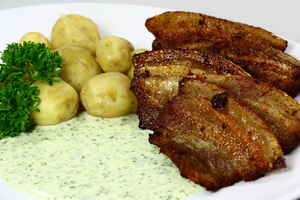
Fried pork with potatoes and a parsley sauce
(Danish; Stegt flæsk med kartofler og persille sovs)
Rye bread;
Makes 3 loaves
1 package dry yeast
½ cup warm water
2 cups rye flour -- sifted
¾ cup molasses
1/3 cup butter
1 teaspoon salt
2 cups boiling water
6½ cups white flour
Soften the yeast in the water. Combine the rye flour, molasses, butter and salt. Add the boiling water
and blend well. Cool to lukewarm. Add the softened yeast mixture. Gradually stir in the white flour to
make a soft dough, mixing well. Turn onto a floured board and cover with a towel. Let rest 10 minutes
on the board. Knead the dough until smooth and satiny, about 10 or 15 minutes. Place it in a greased
bowl, turning once to grease both top and bottom. Cover with a thin towel again and put in a warm
place to rise until doubled in bulk, about 1½ hours.
Punch down in the bowl, turn and let rise until again doubled in bulk, about 30 minutes.
Turn out on the floured board and divide into 3 portions; shape roughly into loaves. Cover them on the
board with the towel and let them rest again for 15 minutes. Shape the 3 loaves more precisely and put
them in greased pans (9×5×3). Cover with the towel and let rise about 1 hour. Brush the loaves lightly
with beaten agg and bake 35 to 45 minutes in a preheated 350º oven.
Thursday, August 23, 2012
Language barrier I
When entering a new country there always seem to be some language barrier. Especially if english is not the mothertongue. There can be language barriers in Denmark too, concluding that the language mostly spoken is Danish. Normally, and especially in small towns, nothing will be written in other languages but danish.
The danish alphabet has three single letters which isn't found anywhere else in the world. Those are 'æ', 'ø' and 'å'. If written in the old danish language it will be 'ae', 'oe' and 'aa' which is why towns such as Aalborg and Aarhus is written the way they are. Those citynames has been changed from Århus to Aarhus to make it more international. So if you have an old map saying 'Århus' instead of 'Aarhus' - it's definetely the same town!
A few words and shortenings that indeed will make everyday-life in Denmark easier is following:
'Hej' = is pronounced as 'hi' and means the exact same. Many english versions of 'hello' will be heard though and among young people also greetings in other languages will be heard.
'Jeg vil gerne have ....' = I would like to have ....
'Hvor fnder jeg ....?' = Where do I find ....?
Directions:
'Højre' = right.
'Venstre' = left.
'Lige ud' = forward.
'Vend om' = turn around.
For a short funny notice the cake called 'Danish cake' in America and I believe every other country calls it 'Danish cake' too, is called 'Wienerbrød' in Denmark.
The danish alphabet has three single letters which isn't found anywhere else in the world. Those are 'æ', 'ø' and 'å'. If written in the old danish language it will be 'ae', 'oe' and 'aa' which is why towns such as Aalborg and Aarhus is written the way they are. Those citynames has been changed from Århus to Aarhus to make it more international. So if you have an old map saying 'Århus' instead of 'Aarhus' - it's definetely the same town!
A few words and shortenings that indeed will make everyday-life in Denmark easier is following:
'Hej' = is pronounced as 'hi' and means the exact same. Many english versions of 'hello' will be heard though and among young people also greetings in other languages will be heard.
'Jeg vil gerne have ....' = I would like to have ....
'Hvor fnder jeg ....?' = Where do I find ....?
Directions:
'Højre' = right.
'Venstre' = left.
'Lige ud' = forward.
'Vend om' = turn around.
For a short funny notice the cake called 'Danish cake' in America and I believe every other country calls it 'Danish cake' too, is called 'Wienerbrød' in Denmark.
Subscribe to:
Comments (Atom)